
Enabling and Utilizing eDirectory API
Introduction
The eDirectory API allows external applications and services to retrieve supported data from your eDirectory website and integrate it with other systems. It can be used for purposes such as retrieving listing information, building integrations with external applications, and developing custom solutions that interact with supported eDirectory endpoints.
This article explains how to enable the eDirectory API, access its documentation, understand its authentication methods, and identify its current capabilities and limitations.
Before developing an integration, it is important to review the available endpoints and confirm that the API supports the operations your application requires.
1. Understanding the eDirectory API
The eDirectory API provides access to specific functionality and data through documented endpoints. Its current public API is primarily designed for data retrieval and selected account-related operations.
Depending on the endpoint, the API can support operations such as:
- Listing retrieval: Retrieve information about supported listings, including individual listings through their IDs.
- Search and data access: Access data exposed through the available API endpoints.
- Account-related operations: Access supported account functionality through designated endpoints, subject to their authentication requirements.
- External integrations: Connect eDirectory with other applications and services using supported API operations.
Important: The available API functionality depends on the endpoints documented for your eDirectory version. The public API does not currently provide a general-purpose interface for creating or updating business listings, nor does it provide an endpoint for submitting CSV files through the standard listing import process.
2. Enabling the eDirectory API
To enable the API on your website, follow these steps.
2.1. Access Site Manager Settings
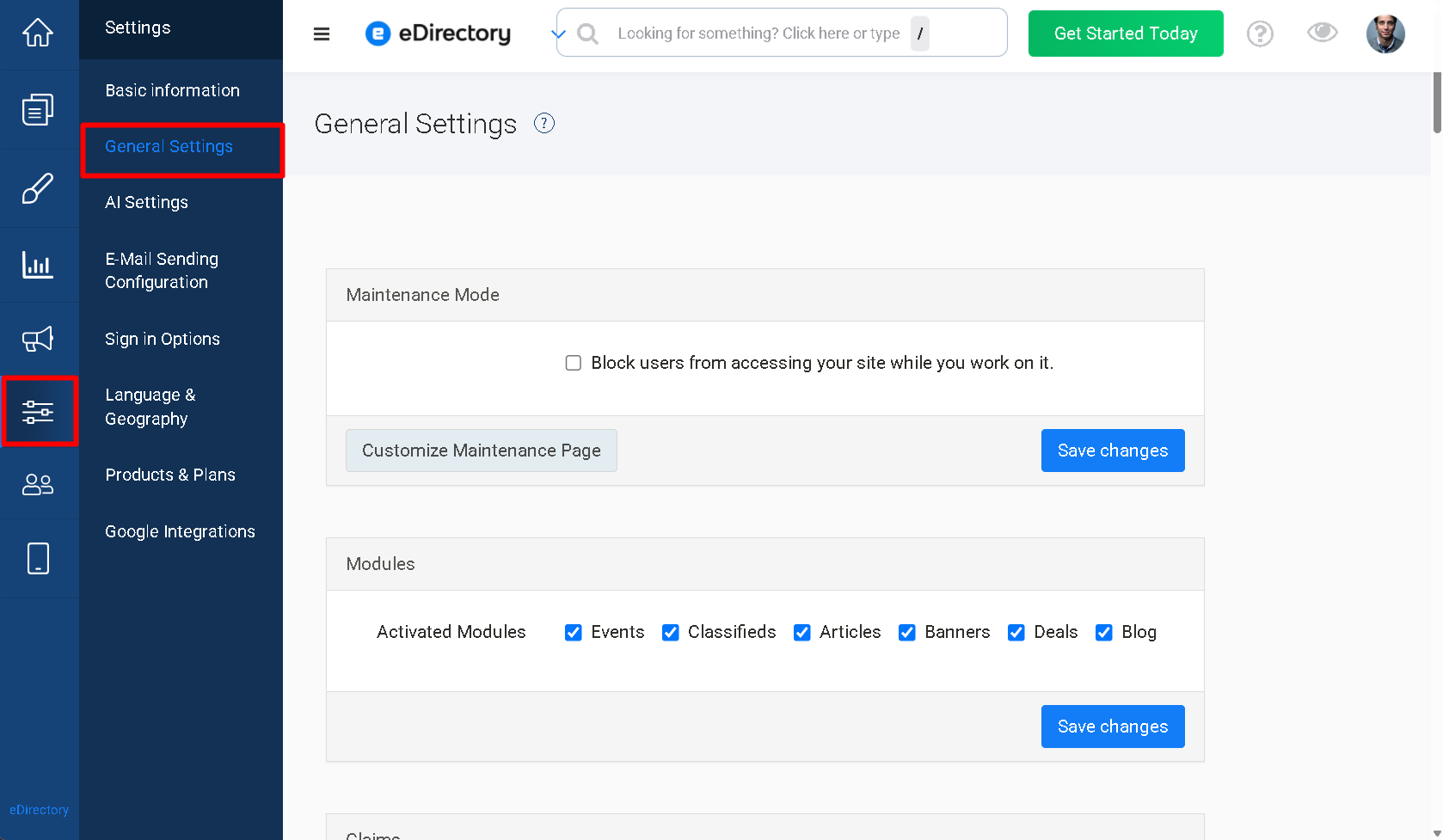
- Log in to your eDirectory Site Manager.
- Navigate to Settings.
- Select General Settings from the submenu.
2.2. Enable the API
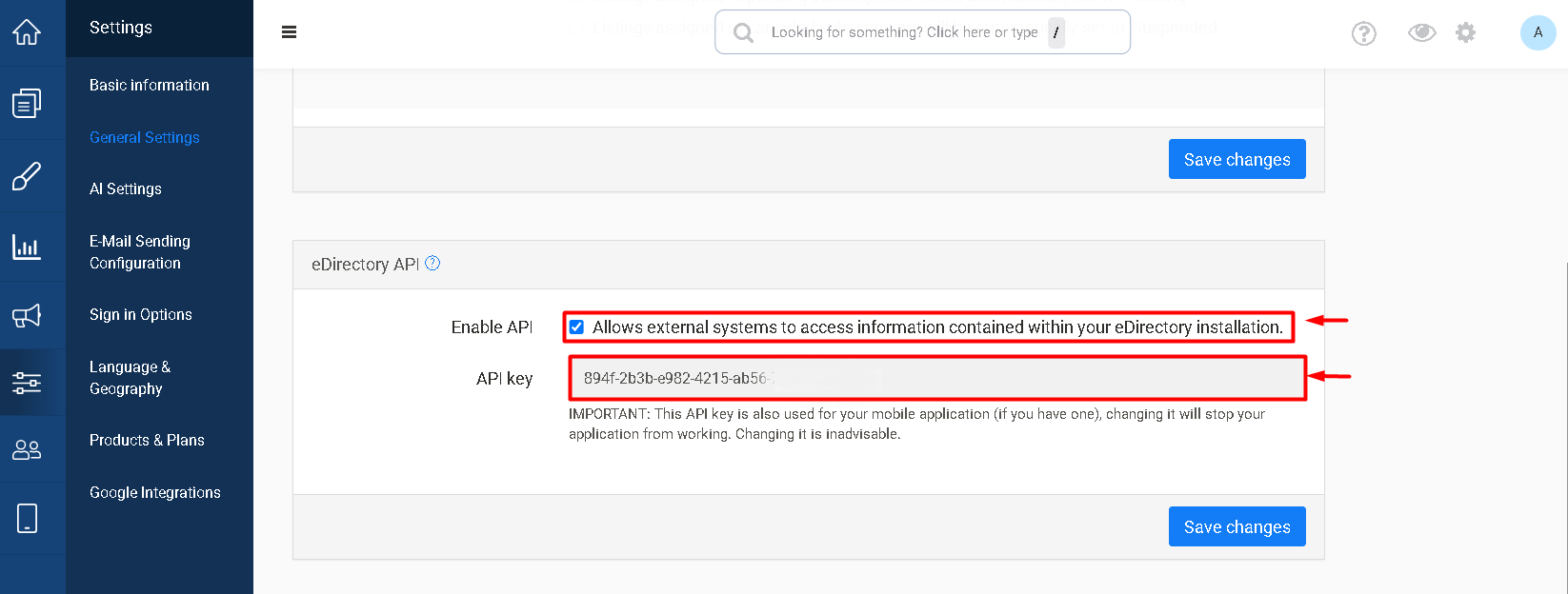
- Locate the eDirectory API section.
- Check the box labeled Enable API.
- The API key for your domain will appear in the corresponding field.
2.3. Save Your Changes
Click Save to apply the changes.
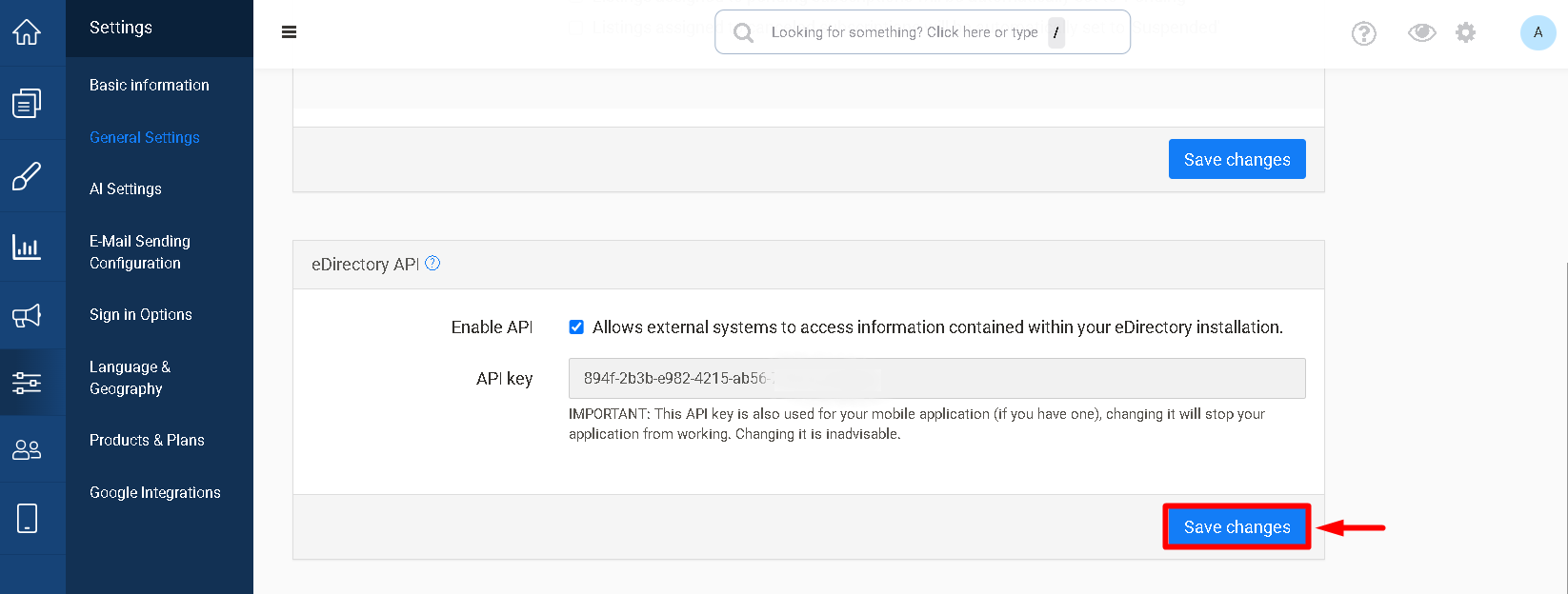
Keep your API key secure and do not expose it in publicly accessible code or client-side applications.
3. Accessing API Information and Documentation
After enabling the API, you can access the information and documentation available in Site Manager.
3.1. Open the API Information Window
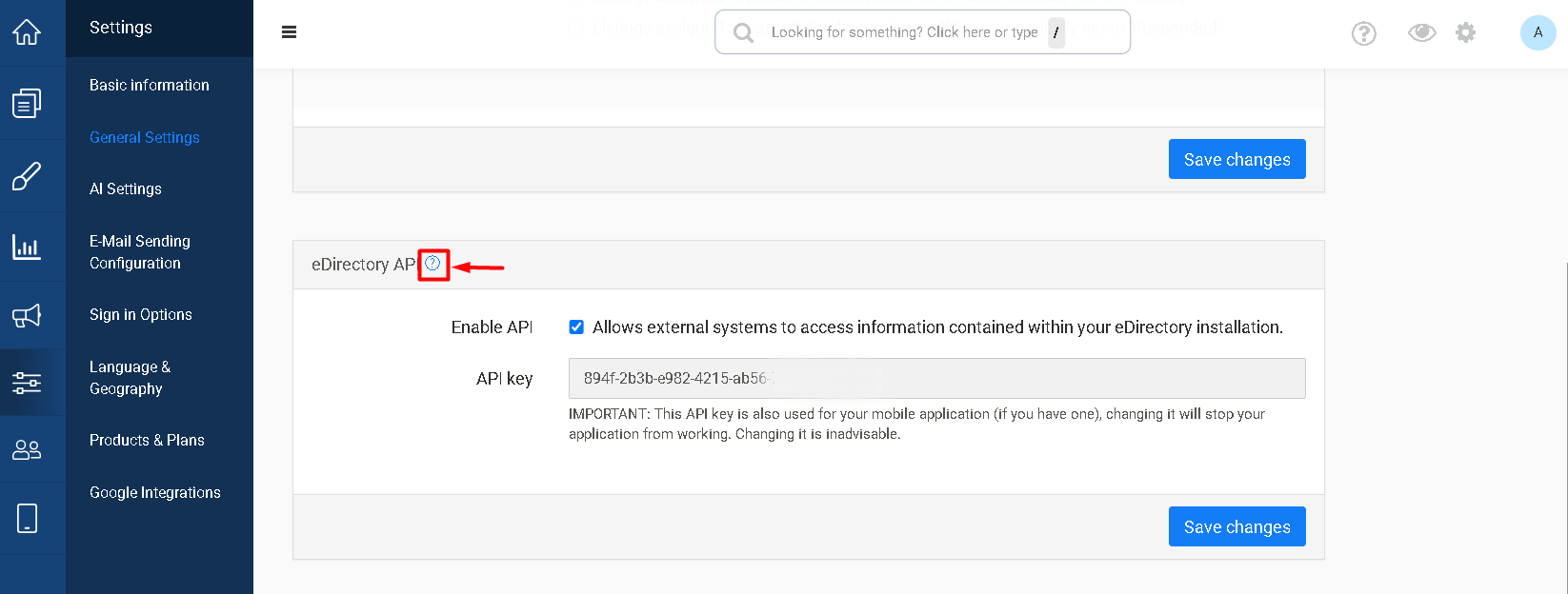
- Under Settings > General Settings > eDirectory API .
- Click the question mark icon next to the API settings.
3.2. API Data Access
A window titled eDirectory API & How It Works will appear.
The information window provides a URL that can be used to access the available API data.
1) Enable your eDirectory API from the form below and take a note of the API key.
2) Use this key with the external application to access your data through the following URL (as an example):
Only use the URL format and authentication method specified in your site's API documentation.
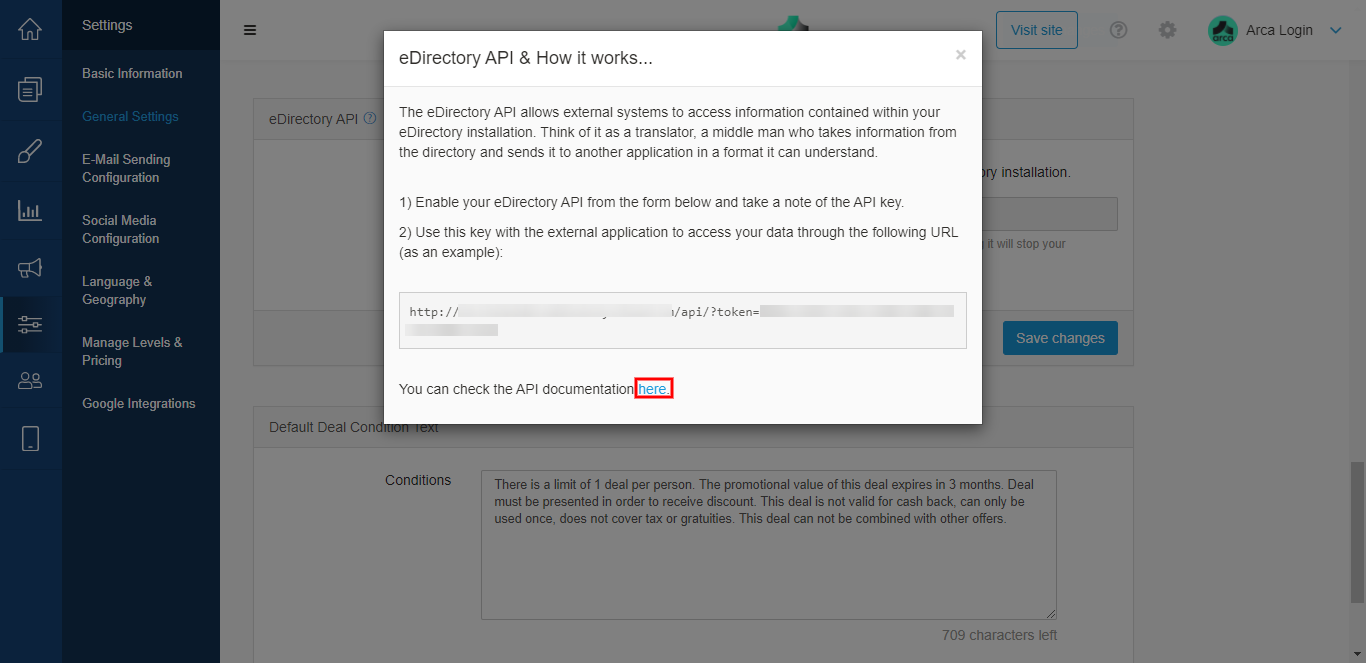
3.3. Open the Full API Documentation
Click the here link at the bottom of the information window to access the full API documentation.
Review the documented endpoints, request parameters, authentication requirements, and response formats before implementing an integration.
4. API Authentication Methods
The eDirectory API supports different authentication methods depending on the endpoint and operation.
4.1. Domain API Key
The domain API key is sent through the X-API-KEY HTTP header.
This authentication method is suitable for server-to-server integrations that need to access supported read-only API functionality.
Example header: X-API-KEY: YOUR_DOMAIN_API_KEY
Replace YOUR_DOMAIN_API_KEY with your actual domain API key. Do not publish the key in client-side code, public repositories, or other publicly accessible locations.
4.2. User-Based JWT Authentication
Certain account-related endpoints, including routes under /api/v4/my/* , use JSON Web Token (JWT) authentication following user login.
This method is intended for the supported user-account operations and is generally not the recommended authentication model for unattended server-to-server automation.
4.3. Security Recommendations
When developing an integration with eDirectory, we recommend the following practices:
- Use HTTPS for all API communications.
- Store API keys and other credentials securely on the server side.
- Restrict access to credentials and rotate them when necessary.
- Consider IP restrictions, security groups, or a Web Application Firewall (WAF) where appropriate.
- Use only the authentication method supported by the endpoint you need to access.
If your integration requires write operations that the public API does not support, a custom endpoint with its own authentication and access controls would need to be developed.
5. API Capabilities and Limitations
Before building an integration, verify that the required operations are available through the public API.
5.1. Retrieving Listings
The public API supports retrieving individual listings through the endpoint:GET /api/v4/listings/{id}
Replace {id} with the ID of the listing you want to retrieve.
Important: This endpoint returns listings that are Active. It should not be assumed to provide access to Pending, Expired, or other inactive listings.
Refer to the API documentation for the required parameters, response structure, and any additional endpoint requirements.
5.2. Creating or Updating Listings
The current public API does not provide endpoints for directly creating or updating business listings.
Consequently, the public API cannot currently be used to create a listing, assign its product or listing level, populate its description and SEO fields, upload its images, or set its initial status to Pending through a general listing-creation request.
These operations must be performed through the functionality currently supported by eDirectory, such as the import feature: How to Import Listings.
5.3. Importing Listings Through CSV
eDirectory provides a standard CSV import process through Site Manager.
However, the public API does not currently provide an endpoint to upload a CSV file and execute the standard import process programmatically.
If you need to automate CSV imports from an external application or server, this would require additional development. The proposed solution would need to be reviewed to determine whether it should integrate with the existing import pipeline or implement a separate, supported workflow.
5.4. Managing Pending Listings and Subscriptions
The public API does not currently provide a ready-made integration profile that allows an external application to create Pending listings while preventing subscription creation, payment processing, activation, or changes to existing records.
Although listings can exist without an associated subscription, automatically enforcing these conditions through an external integration would require a custom implementation.
The required behavior and permissions would need to be defined and reviewed by the Development team.
5.5. Retrieving Import Status and Listing IDs
The standard CSV importer provides import job information, including processing progress and errors, through Site Manager. However, it does not provide an immediate API response containing the ID of every listing created.
The public API can retrieve an individual listing by ID when the listing is Active, but it does not currently provide a complete API-based workflow for submitting imports and retrieving per-record processing results.
If your integration requires listing IDs, validation errors, import-job status, or processing results to be returned directly to an external application, additional development would be necessary.
6. Rate Limits, Licensing, and Import Considerations
Consider the following points when planning an API integration.
- API rate limits: There is currently no rate limit implemented in the public API code. However, this should not be interpreted as a guarantee of unlimited capacity or throughput. Any proposed high-volume integration should be evaluated for performance and infrastructure requirements.
- CSV import limits: The standard importer has operational constraints. As a general guideline, import files should contain approximately 10,000 rows or fewer, depending on the file and processing requirements.
- Licensing: eDirectory is licensed commercially on a per-domain basis. Confirm any licensing implications for your intended deployment with the appropriate commercial team.
- Additional fees and hosting: Additional fees, hosting requirements, or restrictions associated with a custom integration are not defined by the public API itself and should be confirmed with Sales.
- Custom development: Integrations requiring unsupported write operations, automated CSV processing, additional authentication controls, or custom processing responses must be evaluated separately.
7. When Is Custom Development Required?
Custom development may be necessary when your integration requires functionality that is not available through the existing API.
Examples include:
- Creating or updating business listings directly through an API.
- Automatically assigning listing products or setting listings to Pending.
- Uploading CSV files and triggering the standard import process without manual Site Manager interaction.
- Returning newly created listing IDs and detailed validation results to an external system.
- Preventing duplicate records or accidental updates during repeated requests.
- Restricting an integration to specific operations and preventing unauthorized listing activation or billing actions.
- Supporting additional authentication methods or security controls for automated server-to-server workflows.
If you need any of these capabilities, submit a customization request through the eDirectory customization quote form. Our Sales team can help coordinate a review of the requirements, feasibility, estimated timeline, and associated costs.
Conclusion
The eDirectory API provides a way to access supported data and functionality through documented endpoints. By enabling the API and reviewing its documentation, you can determine which operations are available for your intended integration.
The current public API is primarily designed for data retrieval and selected account-related operations. Direct business listing creation and updates, programmatic CSV imports, and comprehensive import-status reporting are not currently available through the public API.
For integrations requiring these capabilities, custom development may be necessary. Reviewing your requirements with our Sales and Development teams will help determine the most appropriate solution for your project.