
How to Enable Google reCAPTCHA
Introduction
Google reCAPTCHA is a free security service provided by Google that helps protect your website against spam, automated bots, and abusive activity.
By enabling Google reCAPTCHA on your eDirectory website, forms such as contact forms, registration pages, and other user interactions are protected by Google's verification system, helping ensure that submissions come from real users instead of automated software.
This guide will walk you through creating Google reCAPTCHA API keys and integrating them with your eDirectory website.
Before You Begin
Before configuring Google reCAPTCHA, make sure you have:
- A Google Account
- Administrator access to your eDirectory Site Manager
- A live domain connected to your website
Important: Google reCAPTCHA requires your website to have an active domain (URL). If your website is still using a temporary URL or you need to change your domain, please contact our support team at support@edirectory.com before proceeding.
Step 1: Register Your Website with Google reCAPTCHA
1.1. Visit the Google reCAPTCHA website and sign in with your Google Account.
1.2. Register a new site by completing the requested information:
-
Label: Enter a name to identify your website. We recommend entering your website's domain name.
For example: edirectory.com
- reCAPTCHA Type: Select Challenge v2 and then choose "I'm not a robot" Checkbox.
- Domains: Enter your website's domain. For example: edirectory.com
Important: The values entered in the Label and Domains fields must be exactly the same and must match your website's live domain. Do not include http:// or https:// in either field.
Example:
Label: edirectory.com
Domains: edirectory.com
- Project name: Google now requires every reCAPTCHA configuration to be associated with a Google Cloud Platform project. Select the project that corresponds to your website. Select the project that corresponds to your website.
Note: This is the same Google Cloud project that was created when configuring the Google Maps API for your eDirectory website.
If you have already configured Google Maps, simply select that existing project.
If you have not yet created a Google Cloud project, please follow our guide: How to Activate Google Maps on eDirectory
Once your Google Cloud project has been created, return to this guide and continue the reCAPTCHA configuration.

1.4. Click Submit.
Step 2: Obtain Your API Keys
2.1. Google may take a few moments to process your request. Please wait until the process is complete before continuing.

2.2. After the process is completed, Google will generate two API keys:
- Site Key
- Secret Key
These keys uniquely identify your website and allow eDirectory to communicate securely with Google's reCAPTCHA service.
Copy both keys, as they will be required during the integration process.

Step 3: Integrate Google reCAPTCHA with eDirectory
For eDirectory version 14.2 and later:
3.1. Log in to your eDirectory Site Manager.
3.2. Navigate to Settings → General Settings.
3.3. Scroll down to the Captcha box.
3.4. Select the Google reCAPTCHA radio button.
3.5. Paste the following values into their respective fields:
- Site Key
- Secret Key
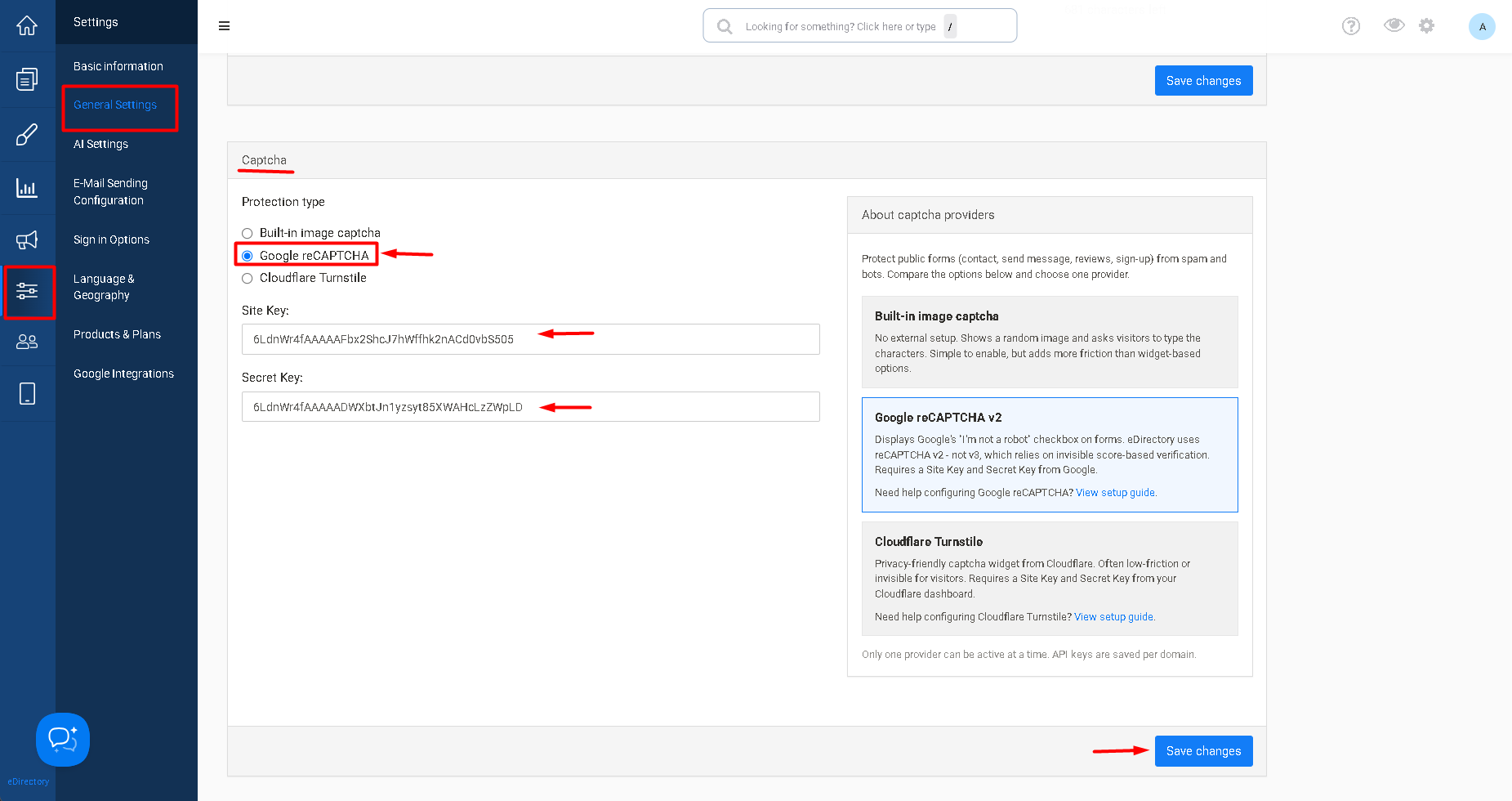
3.6. Click Save Changes.
Note: If you are using an eDirectory version below 14.2, navigate to Settings → Google Integrations → Google reCAPTCHA to enter your Site Key and Secret Key, enable Enable reCAPTCHA, and save the changes.

Step 4: Configure Your Google reCAPTCHA Security Settings
4.1. After saving the Site Key and Secret Key in your eDirectory Site Manager, return to the Google reCAPTCHA page where your API keys were generated.
4.2. Click Go to Settings.

4.3. Under Security Preference, move the slider toward More Secure. This setting increases the level of protection provided by Google reCAPTCHA by requiring stricter verification for suspicious requests.
4.4. Enable the option: Send alerts to owners. This allows Google to notify you if it detects issues with your reCAPTCHA configuration or unusual activity on your website, such as misconfigurations or an increase in suspicious traffic.

4.5. Click Save.
Your Google reCAPTCHA configuration is now complete and optimized for enhanced security.
Verifying the Integration
After saving your settings, you can verify that Google reCAPTCHA has been successfully integrated into your website.
- Visit your website.
- Click Sign In in the upper-right corner of the page.

- In the pop-up window, click Register.
- The registration form will be displayed, and you should see the "I'm not a robot" reCAPTCHA checkbox.

If the checkbox appears, Google reCAPTCHA has been successfully configured and is protecting your website's registration form.
Troubleshooting
I don't see the reCAPTCHA checkbox on my website.
Verify that:
- The Site Key and Secret Key were copied correctly.
- The reCAPTCHA type selected in Google is reCAPTCHA v2 → "I'm not a robot" Checkbox.
- The domain registered with Google exactly matches your website's domain.
- You enabled reCAPTCHA in Settings → Google Integrations → Google reCAPTCHA.
- You clicked Save Changes after entering the keys.
Google says my domain is invalid.
Make sure the domain registered in Google reCAPTCHA matches the exact domain visitors use to access your website.
For example:
- ✅ yourdomain.com
- ✅ www.yourdomain.com (if applicable)
If you've recently changed your domain, you'll need to update the reCAPTCHA configuration or register the new domain in Google.
I see the error "Invalid key type."
This error indicates that the reCAPTCHA key was created using a different reCAPTCHA Type than the one supported by eDirectory.
For eDirectory, you must select:
- Challenge (v2)
- "I'm not a robot" Checkbox
If you selected a different option (such as reCAPTCHA v3 or Invisible reCAPTCHA v2), the keys will not work with eDirectory.
Important: Google does not allow you to change the reCAPTCHA type after a key has been created.
To resolve this issue, you'll need to create a new reCAPTCHA key by following Step 1.2 of this guide again, making sure to select:
- Challenge (v2)
- "I'm not a robot" Checkbox

Once the new Site Key and Secret Key have been generated, replace the existing keys in Settings → Google Integrations → Google reCAPTCHA within your eDirectory Site Manager and click Save Changes.
Conclusion
Congratulations!
Google reCAPTCHA is now enabled on your eDirectory website.
Your website is now better protected against spam submissions, automated bots, and abusive activity, helping provide a safer and more reliable experience for both your visitors and administrators.