
What Is the Difference Between Articles and Blogs in eDirectory?
Introduction
Have you ever found yourself wondering, "Should I use an Article or a Blog? What is the difference between them?" If so, you're not alone! Articles and Blogs are both content types designed to publish written content on your eDirectory website, and at first glance they may seem very similar.
However, there is one important difference between them that determines when each should be used.
This article will help you understand the key differences between Articles and Blogs so you can choose the right content type for your website.
What Is an Article?
An Article is a content type designed to publish informational, educational, editorial, and promotional content on your website.
Articles can be used for a wide variety of content, including:
- Industry news
- Educational content
- How-to guides
- Product reviews
- Travel guides
- Business spotlights
- Opinion pieces
- Resource collections
- Community information
- And much more
Each Article has its own dedicated page where visitors can read the full content.
One of the most important characteristics of Articles is that they can be offered through packages and plans, allowing sponsors or users to create and publish their own Articles on your website.
This makes Articles an excellent option when you want to allow user-generated content on your directory.
Examples of How Articles Are Commonly Used
- Guest articles submitted by sponsors
- Business-written content
- Industry publications
- Educational resources
- Sponsored content
- Community-contributed content
Want to learn more? For a complete overview of Articles, including their fields, features, and use cases, please see: What Is an Article in eDirectory?
What Is a Blog?
A Blog is also a content type designed to publish informational, educational, editorial, and promotional content.
Like Articles, Blogs can be used for:
- Company announcements
- Industry news
- Educational content
- Website updates
- Marketing campaigns
- Opinion pieces
- Tips and recommendations
- Resource collections
- And much more
Each Blog post also has its own dedicated page where visitors can read the full content.
However, Blogs have one important limitation:
Blog posts can only be created and managed by the Site Manager.
Unlike Articles, Blogs cannot be sold through packages or assigned to sponsors or users.
All Blog content is created and managed exclusively by the website administrator.
Examples of How Blogs Are Commonly Used
- Company announcements
- Website updates
- Official communications
- Marketing campaigns
- Editorial content
- News published directly by the website owner
Want to learn more? For a complete overview of Blogs, including their fields, features, and use cases, please see: What Is a Blog in eDirectory?
The Main Difference
The simplest way to understand the difference is:
- Use Articles when you want users or sponsors to be able to publish content.
- Use Blogs when only the Site Manager should publish content.
For example:
Article Example
A website owner creates an Article package that allows sponsors to submit articles about their businesses or industry expertise.
The sponsor writes and publishes their own content through their account.
Demodirectory: https://demodirectory.com/article/tips-for-exercise-and-nutrition.html

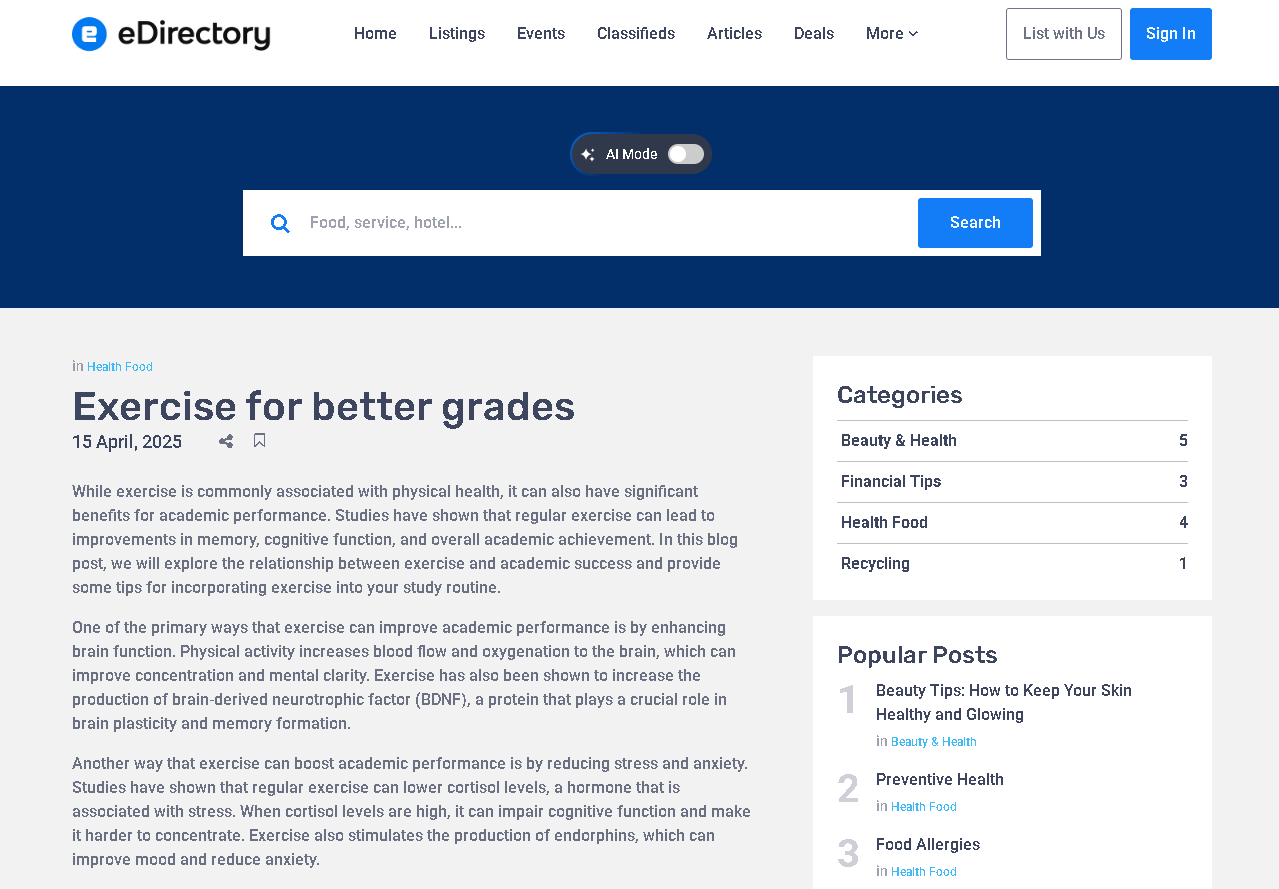
Blog Example
The website owner publishes monthly updates, company news, and marketing announcements through the Blog section.
Only the Site Manager has access to create and manage those posts.
Demodirectory: https://demodirectory.com/blog/exercise-for-better-grades.html
Comparing Articles and Blogs
| Feature | Articles | Blogs |
|---|---|---|
| Written Content | Yes | Yes |
| Dedicated Detail Page | Yes | Yes |
| Categories | Yes | Yes |
| Images | Yes | Yes |
| SEO Information | Yes | Yes |
| Can Be Sold Through Packages | Yes | No |
| Can Be Submitted by Sponsors | Yes | No |
| Can Be Managed by Users | Yes | No |
| Site Manager Can Create Content | Yes | Yes |
| Ideal For | User-generated content | Site-managed content |
When Should You Use Articles?
Articles are usually the best choice when:
- You want sponsors to create content.
- You want to sell content submission packages.
- You want businesses to contribute articles.
- You want community-generated content.
- You want guest authors to publish content.
Examples include:
- Business directories offering sponsored articles
- Community websites with contributor content
- Industry websites accepting guest submissions
- Membership websites with content publishing privileges
When Should You Use Blogs?
Blogs are usually the best choice when:
- You want complete control over published content.
- Only the Site Manager should create content.
- You want to publish company news and announcements.
- You want to share website updates.
- You want an official communication channel with visitors.
Examples include:
- Company websites
- Business directories publishing internal news
- Marketing websites
- Educational websites managed by a single organization
Can a Website Use Both?
Absolutely!
Many eDirectory websites use both Articles and Blogs together.
For example:
- Articles can be used to allow sponsors and users to contribute content.
- Blogs can be used by the Site Manager to publish official website announcements and updates.
This combination provides both community-generated content and administrator-controlled content.
Conclusion
Although Articles and Blogs share many similarities, they serve different purposes within eDirectory.
Articles are designed to support content contributions from sponsors and users, making them ideal for guest posts, sponsored content, and community-driven publishing.
Blogs, on the other hand, are reserved exclusively for the Site Manager and provide a dedicated space for official website communications, announcements, updates, and marketing content.
Understanding the difference between Articles and Blogs will help you choose the right content type for your website and create a more organized content strategy for your audience.